I’ve always liked collage, and Israeli artist, Sharon Etgar‘s simple colour blocking really appeals to me. The tones –– nude, sand, mushroom and terracotta –– in her Collages II series are so earthy and soothing, and I love the bold monochrome in God Figures. Have a look at the beautiful chaos of her thread drawings as well as her highly textured paintings. Etgar lives and works in Tel Aviv.
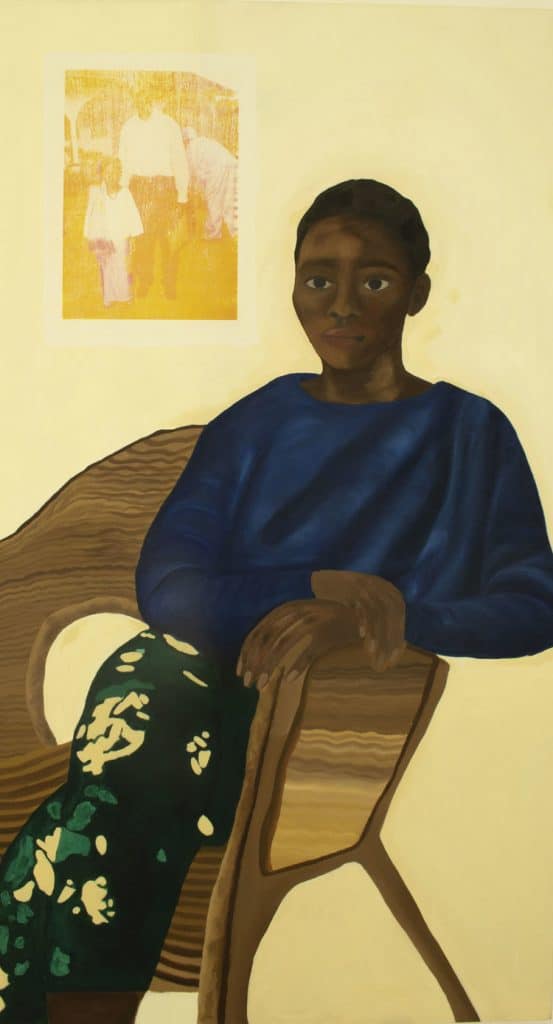
In five years of art history studies, Jean Michel Basquiat was the only black artist that made it into our curriculum. While I am grateful for the curiosity and passion my schooling fuelled in me, the overall picture was shamefully incomplete. We learned about Jackson Pollock, with no mention of the indomitable Lee Krasner. We learned about Robert Motherwell, with no mention of his extraordinarily talented wife, Helen Frankenthaler. There was nary a mention of African American Colour Field painter Sam Gillian. And nor did celebrated collagist and pioneer of African-American art, Romare Bearden make it into our text books. It was only last week, while reading about the Harlem Renaissance, that I happened upon the pure, vivid colours of Beauford Delaney. And what about Aaron Douglas, Palmer Hayden and Archibald Motley? This week, my feed has been chock full of beautiful, arresting art by contemporary black artists such as Chris Ofili, Tobi Alexandra Falade, Lubaina Himid, Kehinde Wiley and Hurvin Anderson, to name a few. We can’t rewrite our education, but we can add to it.
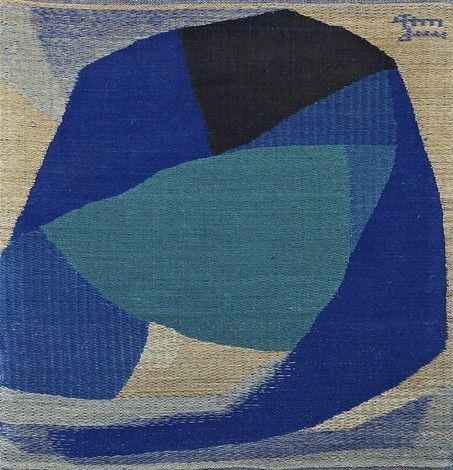
It was this little fish that led me to the work of Damask weaver, Dora Jung. Geometric forms and vivid colours characterize her work, which spans over five decades. Jung’s father bought her a loom when she was a child and a lifelong love of weaving was born. Her more asymmetrical designs and abstract patterns are beautiful; Abstract Blue is a woven painting. “Jung was a person of her time: her pictures were built strongly on a strongly visual ideology,” notes scholar, Päivi Fernström. “This was connected to a mythical power coming from the material and the work of the hands. Jung did not want to give any artistic responsibility to the loom.”
It wasn’t until the late 1920s that technologies in dance photography evolved to allow photographers to capture their subjects in flight. Charlotte Rudolph‘s images of a leaping Gret Palucca advanced both women’s careers, lifting Palucca to international fame, and landing Rudolph centre stage in her field. I love so many of Rudolph’s images, but this one in particular, with none of the tidiness and finesse we associate with dancers, is my favourite.
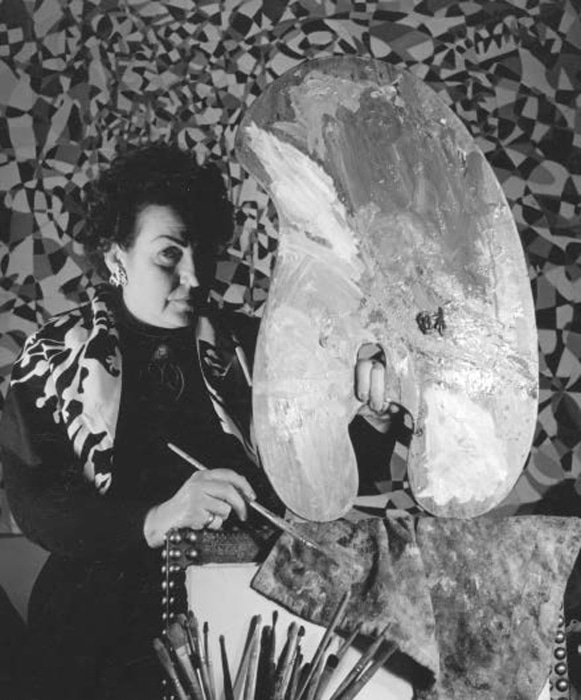
One of my most treasured friends is Turkish. What struck me when we met, was how naturally we gravitated to one another, and how she seemed to have none of the prejudices I would have expected a Turkish girl to have about a Greek girl. I was raised with a narrative, mostly through text books, and elders, that focused only on our rivalry. Buket’s history, the lens through which it was seen and taught, is different to mine. Needless to say, we became fast friends, and two decades later, share a mutual love and admiration for one another that defies stereotypical images. This week, I learned about the work of Fahrelnissa Zeid and immediately thought about my friend, Buket. Zeid was one of the first women to go to art school in Istanbul, and is widely seen as one of the most important female artists of the 20th century. Her extraordinary abstract paintings with kaleidoscopic patterns reflect her many influences, from Islamic and Byzantine art to pointillism and abstraction. Please watch this short film if you have a moment. I found it rich with eccentricity, warmth and colour. “She was the east and the west, combined in harmony.”
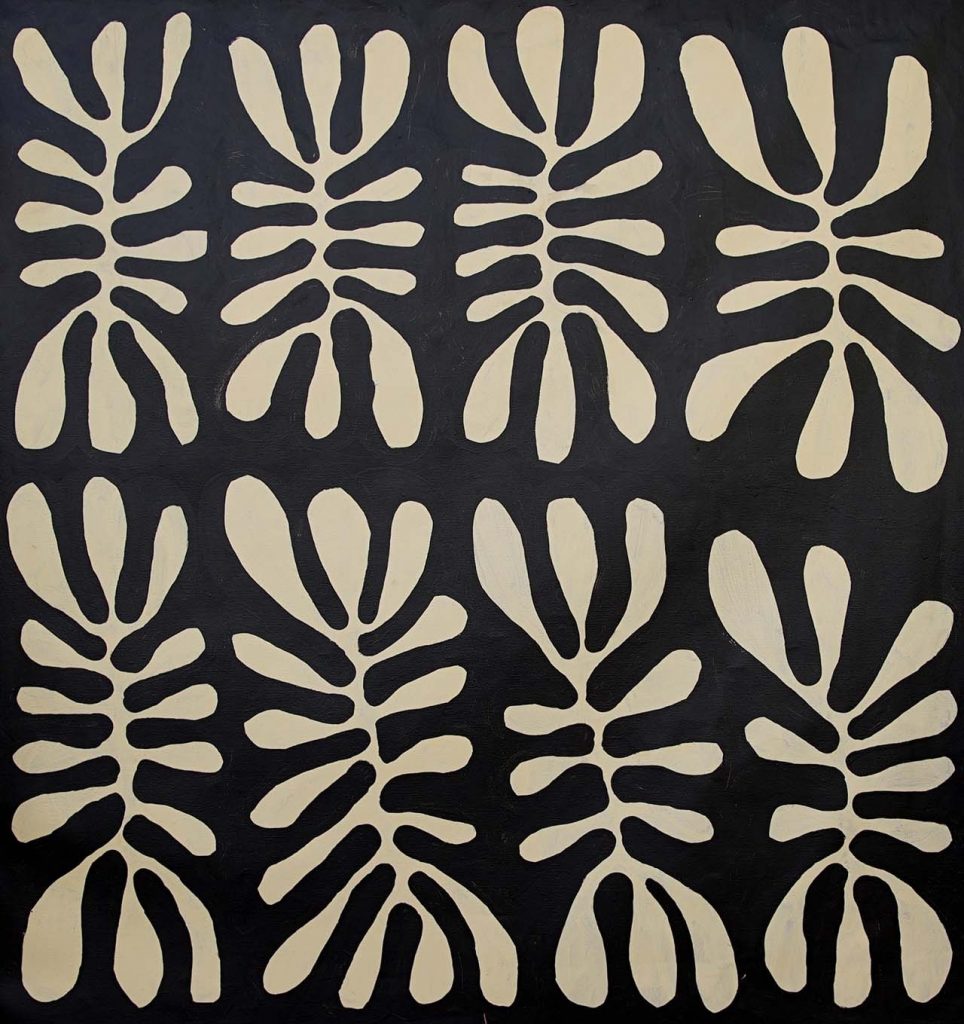
This is such a familiar motif, one that most of us associate with Matisse’s leafy cutouts. But last week, I read about the art and life or Aboriginal artist, Mitjili Napurrula for whom Acacia trees were a central theme. The recurring motif was inspired both by her father’s ceremonial spears (carved from Acacia) and the patterns her mother used to draw in the sand. Before Napurrula became an artist in her own right, she did what many female artists of the Central Desert did, and assisted her husband, Long Tom Tjapanangka produce his paintings. By the 1990s, Napurrula’s artistic career began to flourish. Today, her vivid colours and bold patterns are recognized internationally. Napurrula passed away last year.
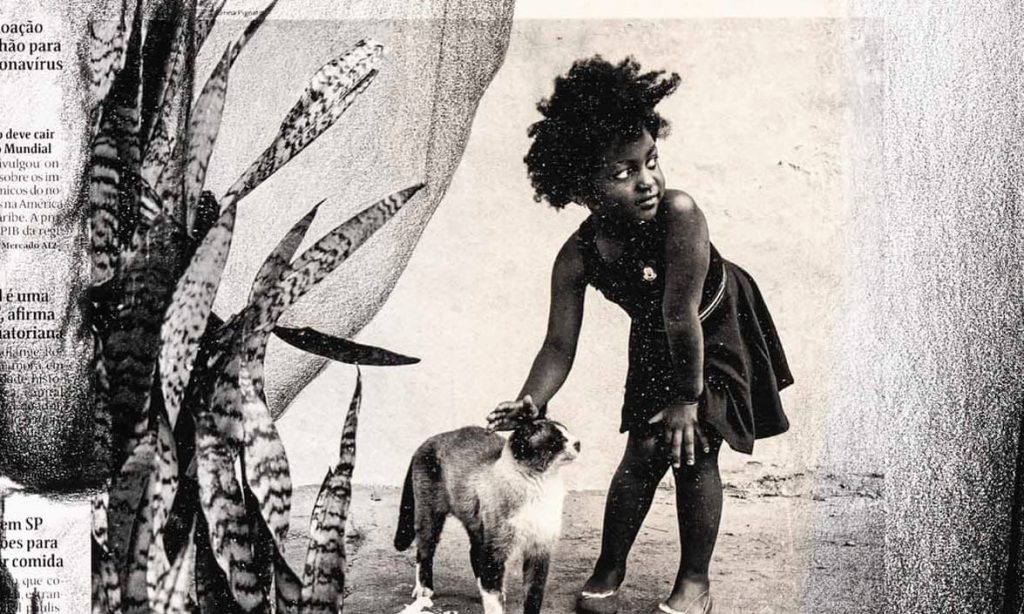
Tatiana Trouvé is a contemporary visual artist based in Paris. Her diary of 40 days in quarantine is a compelling chronicle of a world in lockdown. The project is made up of 40 drawings scribbled on the front pages of newspapers from around the globe. Trouvé chose progressively minded newspapers, like South Africa’s Sunday Times, and Spain’s El País. “The idea was that by reading the newspapers I would get out of the lockdown and find out about life outside. It was about being connected to the rest of the world outside of my studio,” says the artist. “‘Sometimes I would just draw over the front page and insert some moment from my daily life.” She views the project as “a kind of diary, day after day, in my studio, with Lulu, (her dog) my projects and the confinement.” To respect our need for connection, while reflecting on our personal response to isolation, is an idea that may resonate with us all.
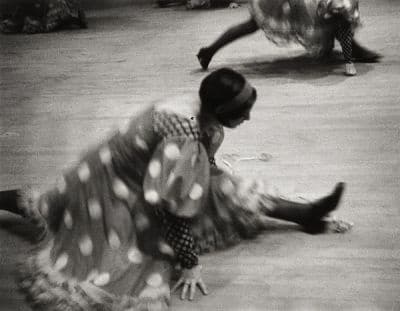
I came across this image today, taken by German avant-garde photographer, Lise Bing of a can can dancer at the Moulin Rouge in the 1930s. I read a little bit about Bing –– an influential photographer, who ran with the likes of Cartier-Bresson, Man Ray, and Brassaï –– but I thought mostly about the dancer in the picture. The strain on her body, to dance night after night, for a pittance. That she was likely a prostitute, who like the famous Jane Avril, had run away from a life of poverty and abuse. That it was a thrilling life, and a gruelling one.
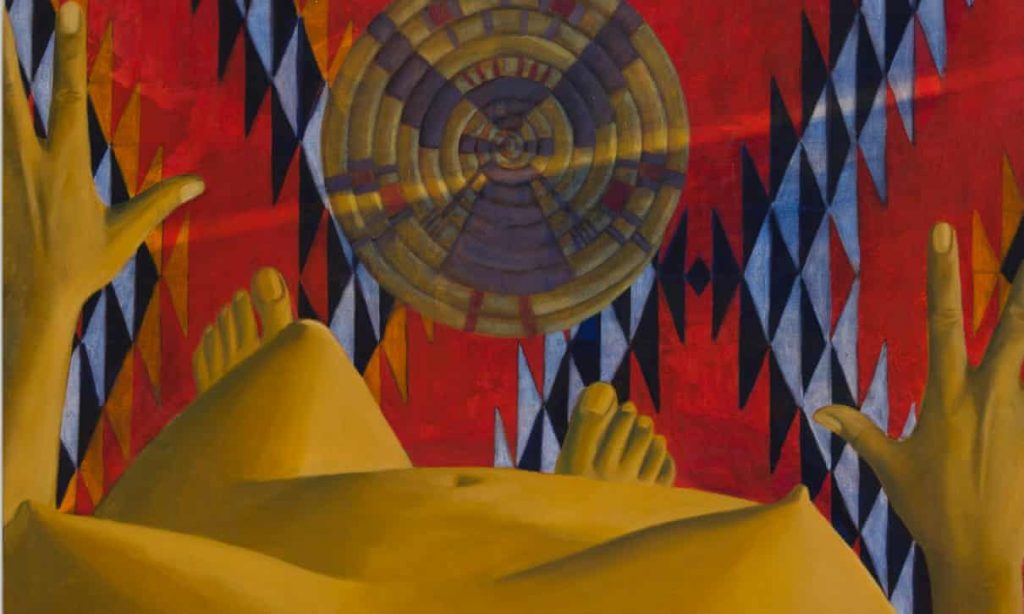
Yesterday, street photographer, Scott Schuman, whose work I have admired for many years, said that he does not feel educated enough to weigh in on the issues and complexities of race, and that for now he is channeling his energies into listening and learning. And doing what he does best, which is sharing beautiful images from recent weeks that have moved him. In the spirit of sharing beauty, and bringing awareness and appreciation to the marginalized, overlooked and misinterpreted, I bring you an artist a day, every day, for as long as feels necessary. At 99, Luchita Hurtado is just beginning to get the recognition she deserves. Although she has made art all her life, it was only recently, when the director of her late husband, Lee Mullican’s estate stumbled upon drawings and paintings signed, “LH” that decades of work was released into the world. Born in Caracas, Hurtado has lived a peripatetic life, between the Dominican Republic, Chile, the USA, Mexico and Italy. De Koonings, Chagall and Léger were all pals. I read that Duchamp used to massage her feet. Themes of motherhood, nature and family are central to her work. “I think I became an artist because of nature,” she says in this moving film. “I remember as a child watching a butterfly break its cocoon and experiencing these extraordinary feelings towards it.” This self portrait painted in the walk-in closet of the home in Chile she shared with Mullican in the 60s, is an intimate perspective on how the artist sees herself, and her surroundings. Reflecting back on the painting, and the streak of light across the Navajo rug, Hurtado now says, “I concluded, that’s all I have in the world, is myself. And I am who I am because I am doing what I want to do, and not what I am told to do.”
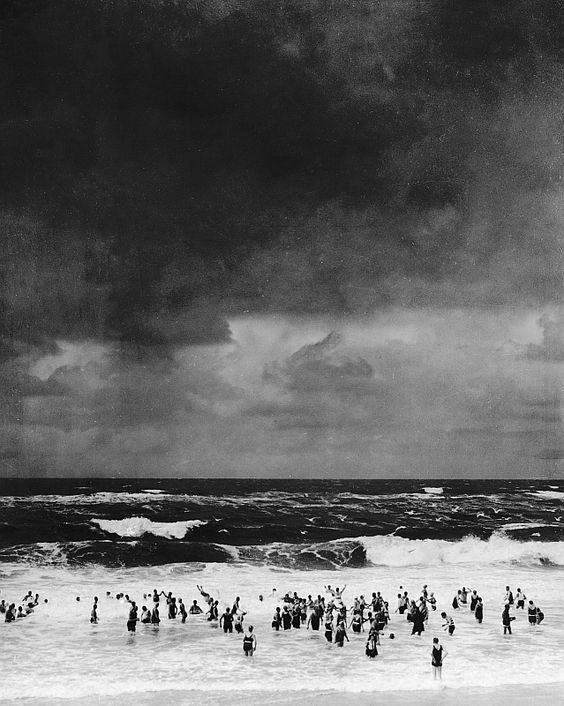
There was a big storm in Toronto last night, a concert of percussion instruments, with lightening and thunder, and beating hale. Immediately, I thought about my Mum, and the stories she told us when storms set in. “Mary must be mopping the floors and rearranging the chesterfields.” It came naturally to her, it still does, to round off the edges of reality with whimsy and humour. To this day, she believes wholeheartedly that children should live out their wonder years for as long as possible, and that answers to challenging questions should be honest, but simple. It’s one of the hardest tasks as a parent, to take complicated issues and make them digestible, without stripping them of their fibre. I’ve thought about all the delicate conversations parents are having with their children this week, and what a responsibility and privilege it is to be a parent today. Teach them how to wipe their bottoms and ride a bicycle; teach them how to manage their pocket money and stand up for their friends; teach them tech etiquette and internet safety; teach them why Marie Curie wasn’t allowed to go to college in her own country, what melanin is, and how amazing it is that our world is filled with so many different kinds of people; teach them how to set a table, and screw in a light bulb, and teach them respect and empathy. “You may not always be able to answer the question in the exact moment that it is asked,” my Mum once said. At a tech talk for parents with kids in Grade 5, the speaker reminded all of us to listen more than we talk. “When talking through tricky issues with your kids, you should be hearing their voices more than your own,” she said. I think we can get so set on trying to convey our messages, impart our knowledge, that we forget to actually listen to theirs. Kids are the wisest among us, because they tune in to what is not being said. They watch, and absorb our actions more than they listen to our words. Teach by example, goes the old adage. We’re going to botch up as often as we succeed. To admit to our mistakes, our ignorance, our shortcomings, shows humility, and is as important a lesson as any other. More. Honesty, peppered with humour. And when lightening strikes, because it will, I hope my children will think of Mary testing her new pot lights, and also know that swimming during a thunderstorm can be dangerous.