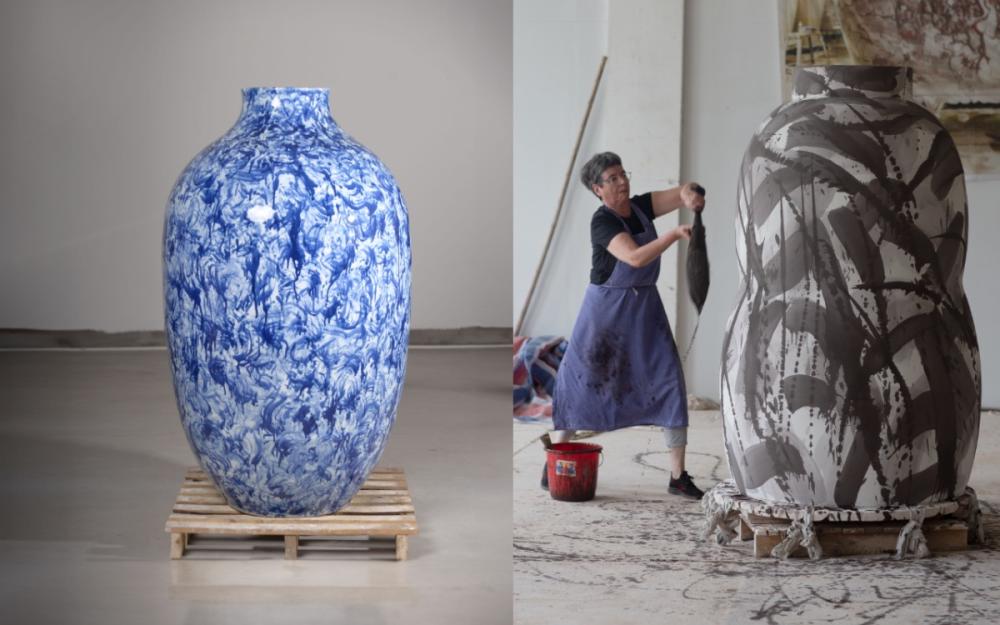
Felicity Aylieff makes gigantic porcelain pots in her workshop in Jingdezhen, China. She wheel-throws each vessel with a team of four artisans and fires them in a kiln that’s larger than most people’s kitchen. Her biggest vessels exceed four metres in height and weigh upwards of 1,000 kilograms. She uses a forklift to move them, even inside her own studio. “I started off making table-top-size ceramics, but I found I couldn’t say what I wanted with the smaller pieces,” says the U.K. born artist. “I love the scale of large sculpture and the impact it has.” I was awestruck when I first saw Aylieff’s work last week; there are very few ceramic artists who dare to work on such an awesome scale. Plus, her surface decoration –– like monumental paintings –– is something to behold. At the opposite end of the spectrum, I came across some images of Lucie Rie’s ceramics buttons this week and felt immediately moved by the respect and sensitivity Rie brought to the lowly button. Rie is one of the most celebrated studio potters of our time, and while she’s known for her modernist vessels, it was the buttons that established her career when as a young Jewish émigré she fled Nazi-occupied Austria to build a life in London. Aylieff’s vessels evoke an instant sense of awe and wonder. Rie’s buttons evoke a feeling of survival and hope. There’s something in the extremes here that I’m drawn to. Big, bold, daring and dramatic; tiny, tender, detailed and deliberate. Humans are a species of extremes so it makes sense that we’re drawn to art that reflects this reality.