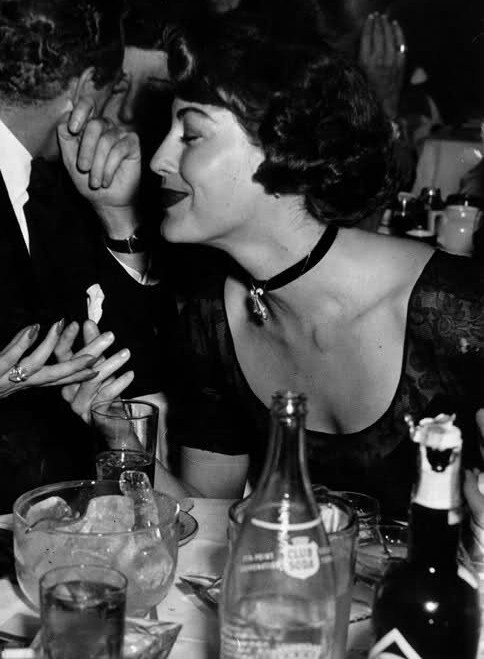
Does anyone remember chokers? I seem to recall a black velvet one, semi-permanently glued to my neck. My daughter wore a pink plastic “lace” one for close to three years. I should have been more embracing of it, given how long I wore mine for. All trends are cyclical. I’m just waiting for her to ask for french tips and a tiny tube skirt. Ava Gardner, at a nightclub in 1950, makes the choker look chic. I think it helps that she’s in a lace cocktail dress, and well, that she’s Ava Gardner.
“Nothing happens until something moves.” I’ve been thinking about movement lately, literal movement, as in walking and dancing, and how crucial it is to our wellbeing. Even the subtlest of movements –– cat to cow –– can have a profound effect. And then the less literal kind, a shift in attitude and perspective. A call to action. Often, the former supports the latter. I almost always think better, feel better after I’ve walked. Or swum. Or stretched. These days, I’m moving slower than usual. I think the whole world is. Slowly, one foot in front of the other, one day at a time. Here, Carmen De Lavallade dances with her three-year-old son, Leo. Marimekko models skip in the street, and Audrey Hepburn begins her yoga practice.
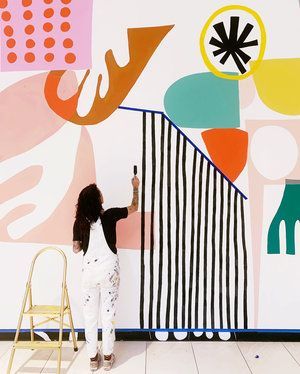
Ashley Mary‘s candy hued paintings –– think bold shapes in pinks, yellows and electric blues –– have such a cheerful vibe. How could this little print not bring zing to a room? Her murals, all over Minneapolis where the artist lives, are eye popping. She’s collaborated with several other artists –– fashion designers, jewellers, quilters –– bringing her signature style to a swimsuit, skateboard or socks. Her curiosity studio brings people together to paint, play and explore. Have a mosey. Buy some socks.
There are about 12 steps to making a ceramic plate, from rolling out the initial slab, to folding up the rims on each circular shape, to smoothing out lumps and bumps, to painting, to carving, to firing, to glazing, to firing again. From start to finish, with two firings in between, a plate usually takes me about two weeks to make. And that’s just a plate. Imagine a teapot! Each step has its own challenges, each step is satisfying in its own way. Timing is everything. Nothing can be rushed. I find the process of smoothing down a slab quite meditative. Painting and carving require intense concentration. Glazing can be such a chore. I’m such a sloppy glazer. It’s a shame when I’ve worked so hard on making something, only to botch it in the glazing phase. Or when I’ve worked so hard on a plate that cracks beyond repair or warps in the firing. It truly is a labour of love, (how much can one charge for a four inch ceramic dish?) so one has to enjoy the process, learn from it. “When you buy something from an artist, you’re buying more than an object. You’re buying hundreds of hours of errors and experimentation. You’re buying years of frustration and moments of pure joy. You’re not buying just one thing, you are buying a piece of a heart, a piece of a soul … a small piece of someone else’s life.”
What a fabulous kitchen this is. Everything from the ceramics, to the tiles, to the wooden spoons and woven baskets exudes charm. I love the pea green cabinetry. This is a kitchen where calamari get fried and eggs get served en cocotte. Invite me over, please. I’ll do the dishes.
I stumbled upon images of the Spitalfields home of actor and teacher, Rodney Archer today and I was a little captivated. Textile patterns line the walls, and every room is chock full of bric-a-brac and antique furnishings. A lovely fireplace, painted gold and Prussian blue, sits in the living room. The mantle once belonged to Oscar Wilde, and Archer brought it for ten pounds from the workmen renovating Wilde’s former Tite Street home. Archer died in 2015, and I’d imagine the home and its contents have been sold on. In a short film, made in 2010, Archer speaks lovingly about the house and the neighbourhood. Of Spitalfields Archer said, “there are still people making a lot of noise, it’s still a bit rowdy and rough, which is what attracted me to the area in the first place. There are still prostitutes in alleyways and there are still alcoholics and glue sniffers. So despite all the fashion and the new British art that has moved in here it still has a bit of grittiness from the 19th century.” Of the condition of his early 18th Century home when he bought it, Archer says, “everything was painted turquoise blue and it was an Indian cab rank and there were pictures of Indian film stars all over the panelling.” For Archer, the home was an ever-evolving thing, a bit like a marriage. “The house has its own character, and I have my character. The house is saying, ‘I want to remain like this, but you can change it a little bit. But I still want my personality and you can still have yours.'” Have a gander around. There’s so much atmosphere in the photos, I can only imagine what it was to visit.
I’ve always enjoyed sculptures made of plaster. There’s something about the material that’s both humble and irreverent. It doesn’t have the grandeur of marble or bronze. I came cross the wonderful plaster lamps of artist, Viola Lanari today and I was immediately drawn to the tactility, playfulness and sense of humour in her work. Nature is a central theme, with all its oddities and imperfections. Have a look; there is great imagination at play.
This is my kind of rowing machine, and my kind of rowing experience. Forget the regatta, I want to dress like Audrey Hepburn and row among books, art and antique furniture. I want posture like hers. Yes, this is my kind of rowing experience. The one where you barely break a sweat. The one where Bach plays in the background. The one where your butler brings you Perrier and a profiterole at half time.