Thierry Martenon’s beautifully carved sculptures.
Raspberry meringue pie with mile high meringue.
Bronwyn Oliver’s stunning metalwork.
A house in the hills made from earth excavated from the site.
A yew in the spring by August Sander.


Rugs, pillows, wallpapers, and a fabulous fabric vanity skirt on the bathroom sink, this house on the Deal seafront is a feast for the eyes with rich colours and whimsical textiles galore. I’m a sucker for red and white stripes –– they conjure seaside and circus –– so that fabulous sofa beckons me in. Those kitchen cabinets painted in Little Greene’s ‘Woodland’, are terrific and I love the contrast with the delicate pink of the Farrow & Ball walls. It all feels so bright and cozy and warm, and the mismatch of print, pattern and colour, although very deliberate, adds to the laissez-faire-ness of it all. It’s such an art, creating a mish mash aesthetic that feels as considered as it does spontaneous, and that delights and surprises at every turn.

Shane Drinkwater (great name) covers his canvases in lines, dots, stars, and concentric circles that form a kind of mystical code reminiscent of ones left on blackboards, scraps of paper and cave walls. A fascination with maps, medieval illuminated manuscripts and astrological charts inform his practice. The work is visually intense with so much beautiful detail to absorb. It invites us to focus, hone in on those details, and crack the code as we see it.

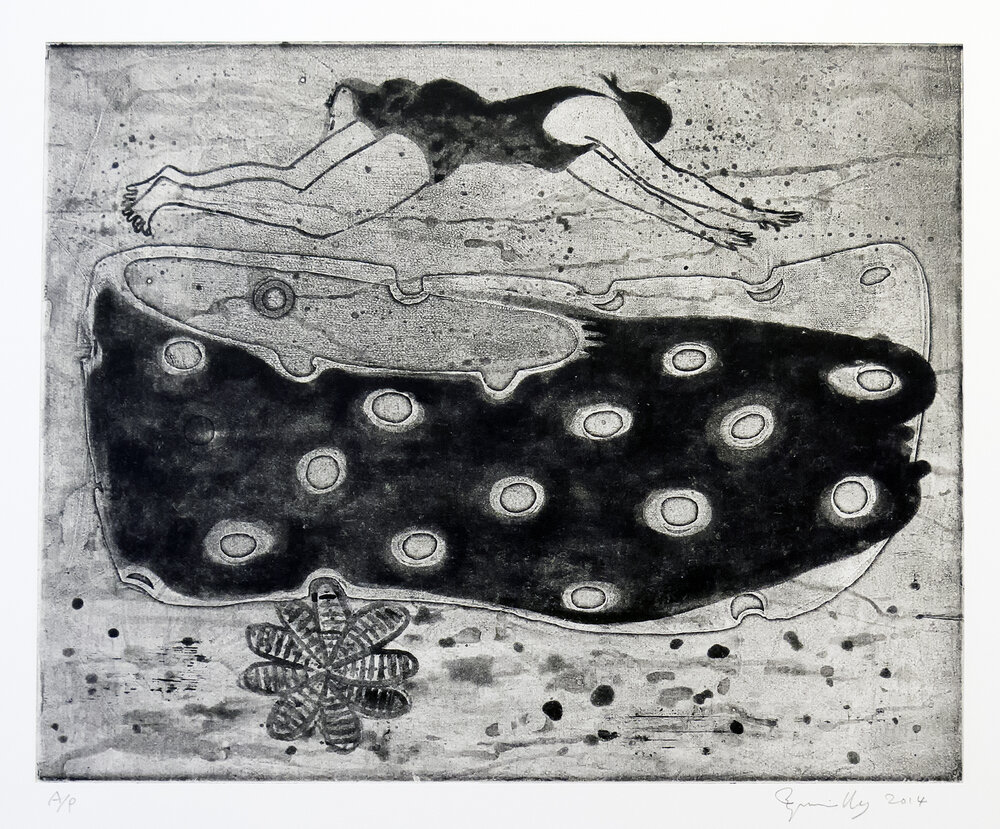
There are a few things I’d like to master in the coming years, and one is a flip turn. In all my years of lap swimming I never got around to it. Another thing I’d love to be able to do is ride a bike with no hands. I watch people swoosh down my street, arms stretched out wide, and I feel a vicarious thrill. Next is sewing. It’s unlikely I’ll ever make a pair of trousers, but I’d like to sew a button like a pro. I’ve never really got the hang of chopping an onion, at least in such a way that doesn’t end in tears, so I’d like to re-visit my knife skills at some point. Drive a car. Better yet, drive a car well. Argh, that’s still on the list. There’s just so much about life that we never really master, bur rather muddle through, so if there are a few things I can do with my eyes shut –– swoosh, flip turn and sew a button –– I’m going to try.
When the Cherry Blossoms at Robarts Library are in full bloom I know that winter is well and truly over. They always seem to catch me by surprise, even though I’ve been willing them to open for weeks. This year, droves of people (and their cats and dogs) have come to admire the trees in all their glory, despite the surrounding construction. Oddly, I’ve never seen so many people before. Is it that everyone is embracing Spring with a more open heart? Are there more weddings in the works –– hence all the engagement photos –– after Covid stuck a wrench in people’s plans? That, too. Are people just looking for shit to add to their snapchat stories? Tik, tok, tik. My children have all mastered the art of surreptitiously cutting blossoming branches from trees to bring home to their Mum; goodness knows where they picked up that habit. I’ve been to see the trees a few times; if I squint my eyes and look up, I may as well be on Mount Yoshino.

I always think glazing takes less time than it actually does. Come to think of it, I think most things take less time than they actually do. I’m working on that. You know, slowing down, taking on less. Clay can’t be rushed, and the glazing stage is no exception. It’s such a shame when days of work end up in the bin because the glaze was slapped on in a hurry. I paint on my glazes which is finicky and laborious. There are other techniques –– easier and more efficient ones –– but I’m stubborn, and that’s what I’m used to. Don’t expect to see a change if you don’t make one. Yada, yada, yada. Another thing to add to the list. Glazing is my least favourite stage, but it’s a stage that can make or break your piece. The icing on the cake, if you will. These porcelain cake sculptures are by Jacqueline Tse. Sweets and skulls –– enjoy!

Born in Morocco and raised in Belgium, Mous Lamrabat‘s photographs are an eye-popping fusion of his Arab heritage and the Western symbols he grew up with. Think models dressed in Gucci djellabas and superhero burkas. “As a child of first generation immigrants, there is always a point in your life where you feel like you don’t fit in anywhere; not in the country you were born in nor in the country you were raised in,” says Lamrabat. “I felt like I was too Moroccan to fit in as a Belgian and too European to fit in as a Moroccan, and this is something that almost every immigrant has to deal with.” Through his photographs, Lamrabat is honing a visual language that captures both the universality and uniqueness of this experience, while dismantling stereotypes and cultural norms and paving the way for something new and more flexible. “As a kid, I loved wearing djellabas and rocking them with my Jordan sneakers. It felt “cool” at that time because that’s who I was: a mixture of identities. Doesn’t it make sense that your “idea-basket” gets larger when you live in different cultures or you live in multiple places in the world?” The eyes, and often the whole face, are covered in Lamrabat’s images, which interestingly, makes his subjects even more accessible. It’s the experience that we’re connecting with rather than the individual. “I love creating from a perspective that it’s not about one person,” he says. “The face takes so much information away and doesn’t leave that much to the imagination…. I feel when the face doesn’t show, the person who is looking at the image puts their own face in there.”

It was a rookie mistake to put my orange tree on the deck last June. I’d been caring for it all year, and I was eager to see it flourish under spring showers and sunshine. It seems so stupid now that I didn’t do it gradually. Of course the intensity of midday sun would bleach its verdant leaves acid yellow. And all that rainwater must have choked the poor thing. What was I thinking? I quickly brought it back in and crossed my fingers that it would convalesce in its original spot and bare fruit again in the coming months. No such luck. One by one its yellow leaves started to fall, despite my continued commitment. Then came the familiar quandary that all plant owners face, and why so many of us avoid buying them in the first place; do I ditch the plant and replace it with another one, or do I carry on taking care of an unhealthy one that may or may not thrive again in a year? “Pull it out of its pot, wash the roots and plant it in new soil with a helping or two of fertilizer,” was the advise of my green thumbed neighbour. “And then watch it for a year.” Gosh. On the day of the transplant, I walked past a beautiful orange tree potted in an amber planter in the window of a flower shop on Bloor Street that I’m sure the universe put there to tease me. “Take me home, forget the other one,” I heard it whisper. I nearly caved. I’m giving my little tree six months. I’ll need to see progress, even a tiny bit. Isn’t that what anyone needs to stay hopeful?

Dutch artist, Marian Bijlenga works with unusual material such as horse hair, fish scales and porcupine quills. Her textile wall reliefs are an homage to lines and dots. Patterns are repeated, but as in nature, it’s the irregularities that make her designs interesting. Pockets of white space create a dialogue between the work and the wall it hangs on. “By leaving some space between the structure and the wall the object is freed from its background and interacts with the white wall,” says Bijlenga. “It becomes what I call a ‘Spatial Drawing.'” I love her work with fish scales, particularly this collection of them on Bijlenga’s studio wall. Loose and structured, geometric and organic, black and white and vividly colourful, the possibilities are endless.

All rights reserved © La Parachute · Theme by Blogmilk + Coded by Brandi Bernoskie
