Posts from December 2020

winter

December 17, 2020

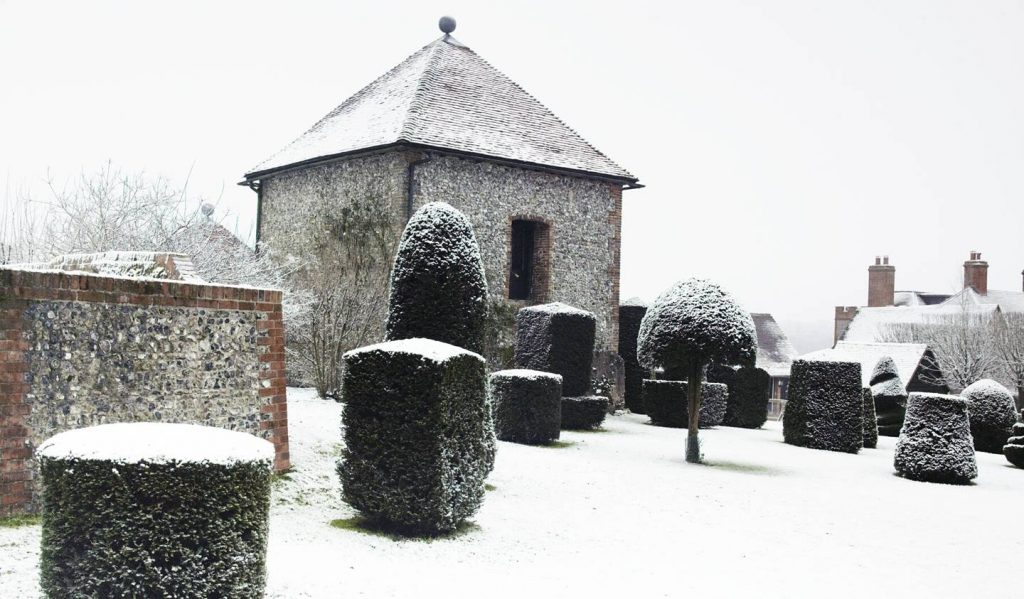
What I’ve always resisted about winter, beyond the bone-chilling cold, is how the city seems to shrink into itself. Between its barren Maples and empty terraces, there’s little sign of life. Without foliage to blanket the grey, Toronto is very concrete. The cold hurries us into our homes, and neighbours rarely stop to say hello. There are no kids on bikes, or elderly Italian ladies nattering on porches. All is quiet. All is still. And yet this year, there’s something in Winter’s repose that feels fitting. Perhaps, we’re all acclimating to the quiet, to not making plans, and to spending long hours in our homes. There is a time for everything. And winter is when we rest. It may have taken a pandemic to help me appreciate that.
verdant

December 16, 2020

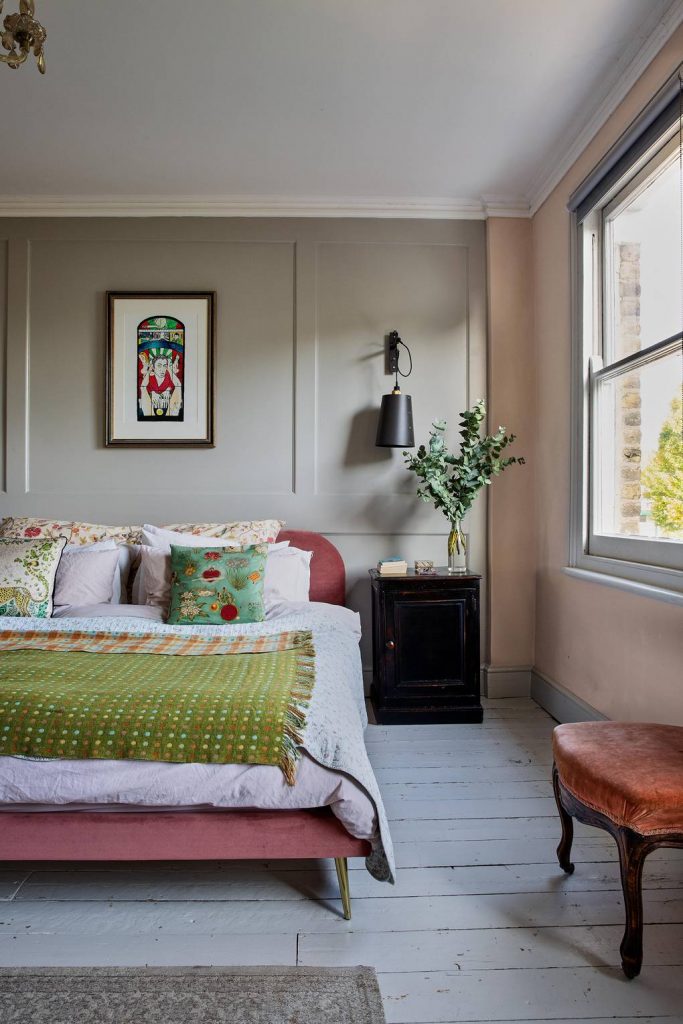
I love the colour green, all shades of green, and this London home with it’s bursts of emerald, sage and avocado, jumped off my screen this morning. The pistachio paint around the Crittall windows is superb, as are the dark muddy green walls in the dining room. The antique chair, upholstered in moss green velvet caught my eye, as did the eucalyptus, hydrangeas and leafy plants throughout. The greens pop against an otherwise subtle palette. It’s all quite lovely and calm.

monochrome

December 15, 2020

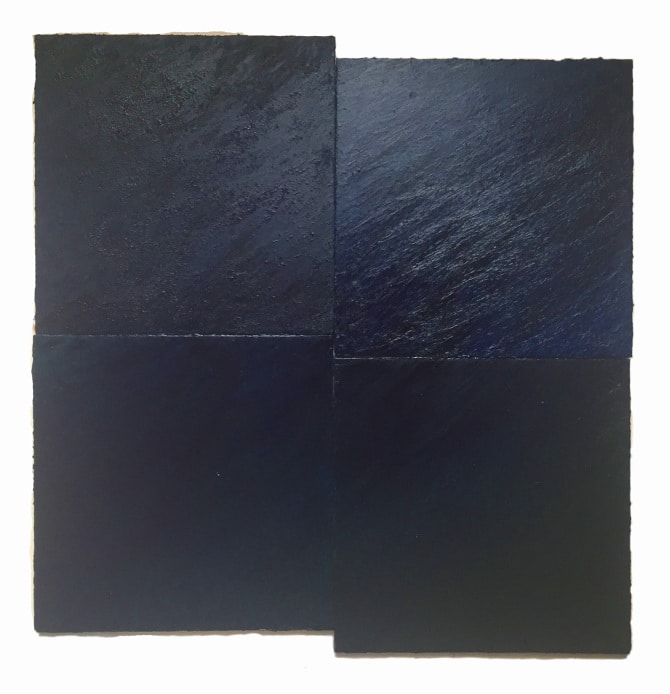
I’ve been thinking about artists who work with one colour –– Kazimir Malevich‘s white on white paintings, Wolfgang Laib‘s installations of yellow dust and Yves Klein‘s cobalt blue sculptures. And I’ve been thinking about how there is freedom in focus, and how liberating it can be to set limits. For many artists, a single colour provides a gateway to “spiritual purity.” For others, it allows for greater focus on form, texture and process. Anish Kapoor, Robert Rauschenberg and Ellsworth Kelly have all experimented with monochrome. In a recent podcast interview, local artist, Nicole Kagan spoke about how she found freedom in working with nothing but school grade black ink and dollar store white paper. The limitations were liberating, she says. For a week she made nothing but intuitive black marks on paper. It was a reset. Setting boundaries and releasing oneself from the double edged knife of choice can usher in greater clarity and a more deliberate use of one’s creative energy. I think some people might say as much about this last year. That the limitations have been liberating. Enlightening, even. I leave you with a painting by Alteronce Gumby. Gumby’s canvases are slathered with a black paint that he makes himself, and that’s comprised of many colours mixed together. Monochrome. But look again, and you’ll see every colour of the rainbow.

basket case

December 14, 2020

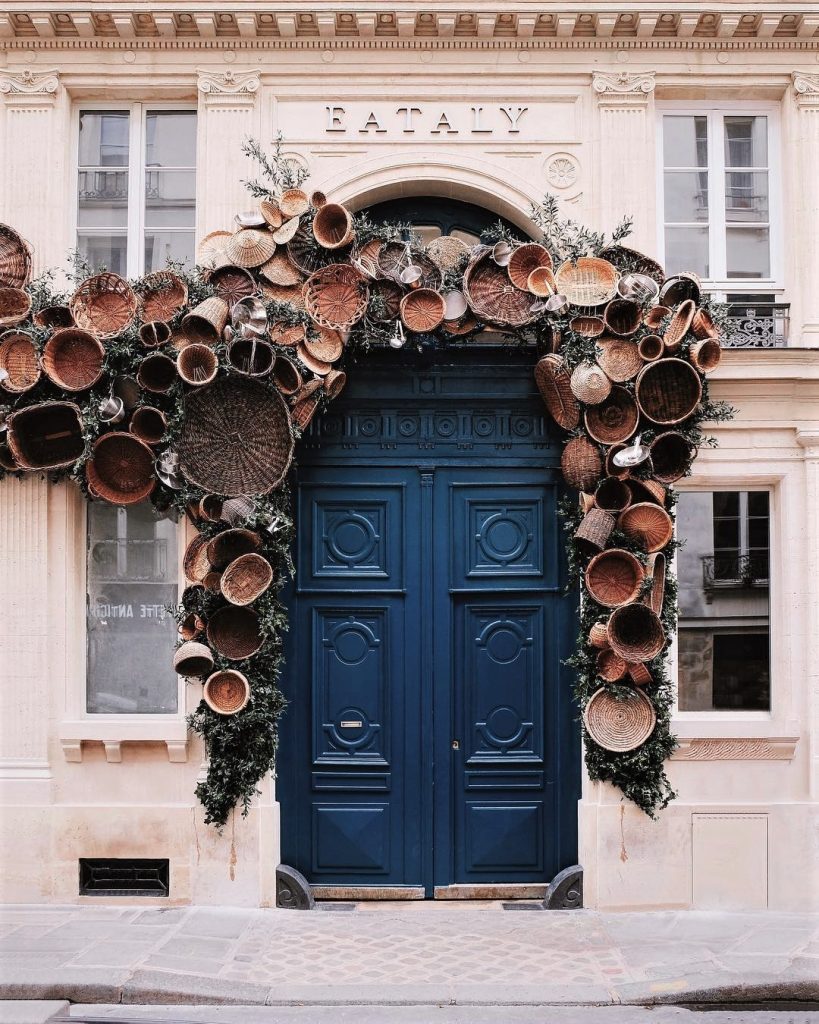
What an imaginative way to decorate a door. From afar, the doors to Eataly, Paris look like they’re covered in dried oranges and walnut shells. I love the way the baskets are arranged; there are even a few pots and pats in the mix. People’s creativity never ceases to amaze me. This is festive, rustic, and utterly decadent.

sinai

December 12, 2020

Luma and I stood outside Mount Sinai today for over an hour waiting for a Covid test, and all the while I thought about her birth. I thought about her birth, and I thought about Antimo’s birth a few years prior, and about Iole’s birth a couple of years before that. I told Luma how we zoomed along Murray Street in the early hours of the morning, and how eight hours later she flew out of me with three almighty pushes. I told her how her Papa and I, with our parents, sat in the Tim Horton’s at the corner of College and University at midnight, me in my nighty and bare feet, eating bagels and drinking tea as we waited for Iole to come. Antimo was the quietest of the three; he arrived with little fuss or fanfare and settled into my chest like he’d lived there forever. The world is weird. A mile long lineup of people, six feet apart, in surgical masks. And there we were, singing Blondie songs, sharing stories, and trying to make it all feel less weird.

gin

December 10, 2020

My grandmother taught me to ride a two-wheel bicycle. She taught me to distinguish a salad fork from a lobster fork and how to make the perfect hospital corner. She also taught me a mean game of Gin. We played for hours, like two old dames, in a 1940s movie. “Breast your cards,” she’d whisper from the other side of the kitchen table. She had beautiful hands; I loved the sight of her French manicured tips pressed against her cards. Years later, my little Florence flat turned into the Gin headquarters, where we’d all convene to play cards, cook and drink Italian plonk. When we travelled, Jason and I always packed a deck of cards for long flights, delays in crummy airports, and rainy days stuck in a hostel with little to do. In Koh Samui, where it rained everyday, we must have played a thousand games of Gin on the porch of our little straw hut. And Shithead. By then our repertoire had expanded to include two games. Shithead is good, too. But there’s nothing like Gin Rummy. Last week, I taught the children to play, and they’ve since made Gin their evening activity. They play for hours. My grandmother’s version was the classic, and ours permits picking up the entire discard pile. We’ve made other adjustments that she’d likely turn up her nose at. But I think she’d be happy to see her great grand children playing cards. “Lucky in cards, unlucky in love,” she’d say to us all, peering over her reading glasses.

narrateur

December 9, 2020

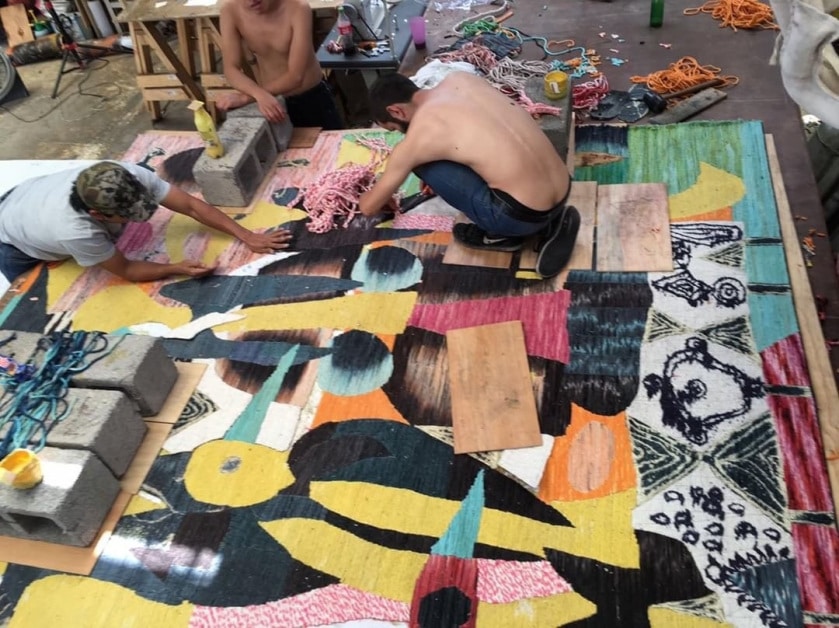
Yann Gerstberger is a storyteller. His large scale textile tapestries are dense with patterns and motifs that tell his stories. Made of hand-dyed cotton fibres (taken from mops) and industrial fabrics that are glued to a vinyl surface, Gerstberger’s process is as crude as it is painstakingly refined. “I started to use mops because they are the most basic, common, easy-to-find kind of fabric,” he says. Gerstberger dyes his fabrics using both natural and industrial dyes. “I sometimes use a sprayer full of chlorine to draw directly on my materials, graffiti like.” As with all great artists, Gerstberger draws from a multitude of influences –– popular culture, Mexican culture, (he lives in Mexico City) Yoruba art –– to create a style that is all his own. Matisse, Picasso and Picabia are all inspirations. “I think what’s cool when you are an artist is you can drive (and eventually run over) those categories because you’re generating another kind of language that goes beyond those definitions,” he says. This short film shows the artist at work in his studio. It’s pretty amazing; his process, the colours, the fantastical shapes and the richness of his story telling.

outside the box

December 8, 2020

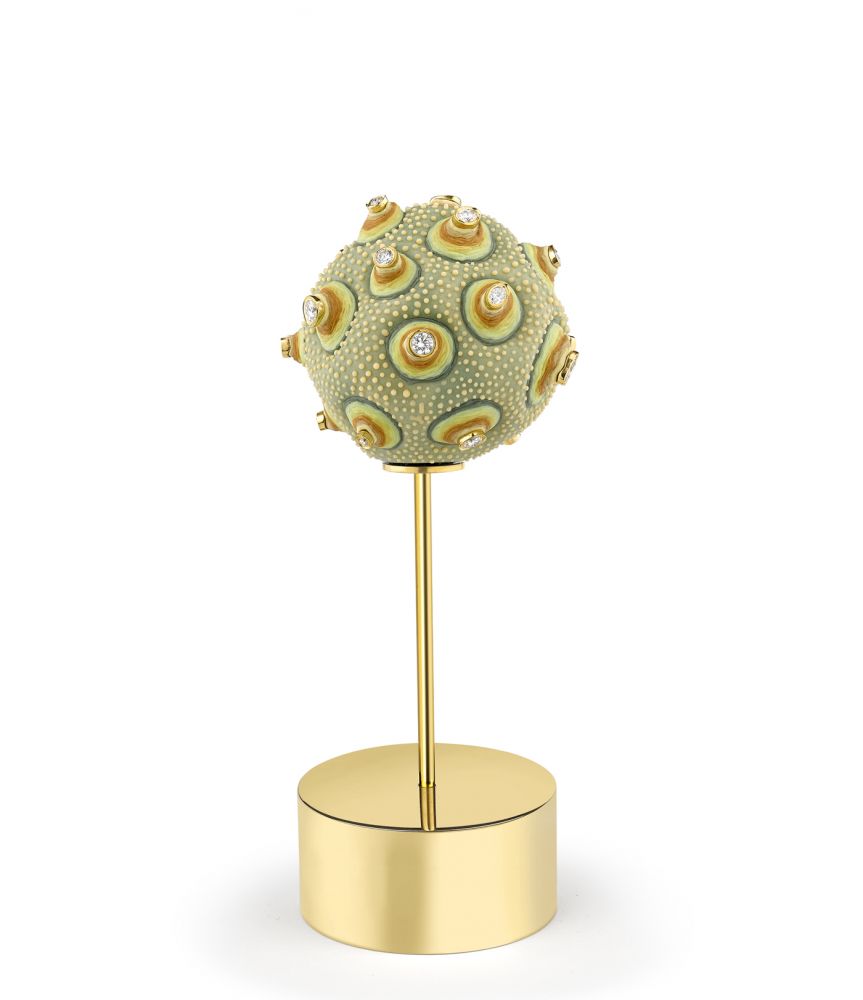
I get really excited when two talents with different aesthetics collaborate on a project. Minds meet, stars align. Boom! Jessica McCormack designs heirloom jewellery that is as classic as it is edgy. The Haas bothers create otherworldly sculptures –– think colourful beasts and sea monsters –– that double as furniture. McCormack, and artists twins, Simon and Nikolai Haas have created a line of jewellery and jewellery boxes that reflects their respective originality, whimsy, sense of humour and play. “Collaborating is fun because you just learn so much,” says Simon Haas. “That’s the exciting part for me, that you get to enter somebody else’s world.” The creative process was very organic. “Once we got started it was like a runaway freight train,” says McCormack. Together, they created bejewelled sculptures –– colour glazed ceramic, whacky textures, and brilliant diamonds –– that are adorable and bizarre. And jewellery boxes –– lined with elephants, cacti and jellyfish trees –– that aren’t your typical heirloom. “We’ve created beautiful things that bring a lot of joy,” says McCormack.

write on

December 7, 2020

“Don’t be afraid to write badly,” says author, and comedy writer, Bess Kalb. “Just get it on the page. Don’t get precious. Don’t worry if it’s good….. because occasionally, good things come out of it.” I love this advice. So many ideas live in a vault because we don’t think they’re good enough to be released. And a lot of the time, they aren’t. But as Kalb says, once in a while there comes a gem –– a rough diamond that we cut and polish –– that turns into something beautiful. We don’t find the diamonds without sifting through the stones. I’ve written a lot of shit over the years, and by shit, I mean words that look pretty on a page, but are too self conscious to have any kind of impact. I’ve also written sentences, that with very few words, none that require a dictionary, perfectly capture a feeling. That always feels like a triumph. Simple, honest writing. There’s a freedom in releasing a thought to the page. At least it’s not rattling about in that tin box upstairs. Spew it out. Tidy up later. And yes, “don’t be afraid to write badly.” In her warm and human memoir, told from the perspective of her beloved grandmother, Kalb does what every writer strives to do; take all the rough edged stones collected over years and turn them into a diamond.

clay

December 5, 2020

“Of all mediums, clay is the most versatile, pliable and human,” says Kenyan-born British studio potter, Magdalene Odundo. The magnitude of possibility never seizes to amaze me. Every potter begins with the same ball of mud. Rogan Gregory morphs his mud into anthropomorphic lights. Barbro Åberg turns clay into spirals, pleats and bubbles. Floris Wubben‘s functional vessels look like parts of a machine. I’m often humbled by how far the medium can be stretched in the hands of someone as daring, imaginative and original as artists such as these. Have a scroll through Ceramic Mix. You’ll be swept away.

All rights reserved © La Parachute · Theme by Blogmilk + Coded by Brandi Bernoskie