I am making a collection of vases inspired by trees. “A tree can be only as strong as the forest that surrounds it,” writes German forester, Peter Wohlleben in The Secret Life of Trees. I feel this way about my collection. The vases compliment one another. They look better together. I came across this image of the Adansonia grandidieri, an endangered species native to Madagascar and it reminded me of my vases. Trees, vases, people –– aren’t we all better together.
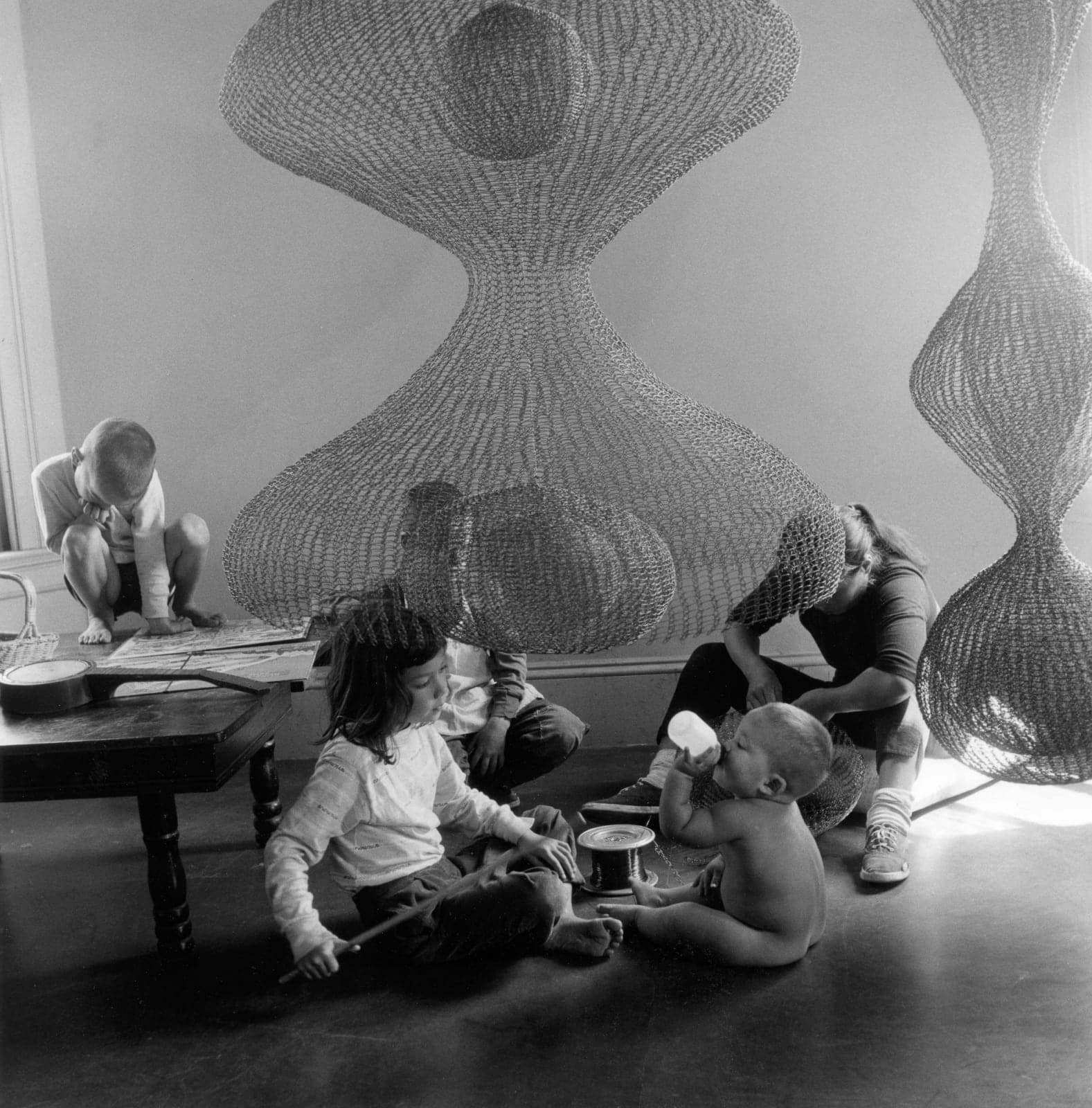
“Sculpture is like farming,” said artist, Ruth Asawa. “If you just keep at it, you can get quite a lot done.” Asawa’s parents were farmers, who emigrated to rural California from Japan, hence the comparison. Asawa discovered the technique of weaving and looping wire while watching basket weavers on a service trip to Mexico in the late 40s. Today, her ethereal wire sculptures hang from ceilings, “like drawings in space” at major institutions all over the world. Asawa had six children, some of whom appear in the image below. If you have a few moments today, this vintage footage of Asawa sharing details of her process and vision is quite lovely. On an artist’s relationship with his/her material, she says, “rather than being concerned with your own design ideas and forcing something into it, what you do is you become background, just like a parent allows the child to express himself…”
I haven’t worn brown since I was 17 ish and all my favourite clothes were the colour of tree bark. I had a long velvet Jigsaw coat that I wore with everything, and a French Connection cardigan that looked like it belonged it to a wooly mammal. There were hits of caramel and aubergine, but brown was the main event. Fast forward a few decades, and I’m kind of into the sepia, carob and cedar of Gembalies latest collection. Minus the drop crotch pants that I wouldn’t have known what to do with, my 17-year-old self would have wanted everything in this collection. Chocolate brown sweater complete with insouciant 90’s rip. Oh, yes.
Polenta isn’t everyone’s thing, but I love it; it’s a comforting substitute for rice or potatoes. In the North of Italy, where corn meal is eaten a lot, polenta was known as “poor man’s food” because it was cheap and filling. This recipe here looks delicious. It’s riff on bangers and mash. I rarely cook, but I may just put a pinny on for this.
There are few words sager than, “one day at a time.” It’s what a wise person said to me in March 2020 when the world turned on its head. I’ve been trying since then to take small bites out of life, only what I can digest, and not looking too far ahead. The weekend forecast? Too far. It’s early Autumn, and with the first few days of October came drizzling rain, orange leaves and cobweb covered hedges. The Halloween decorations are pissing me off, frankly. I find them unsightly and premature. Can’t we just embrace the smell of smoke and falling leaves and the sharpness in the air? Can’t we enjoy the month without feeling catapulted to its gruesome end? My kids on the other hand love the ghouls on our neighbour’s lawns. They love them for the same reason why we plant peonies in the Fall, or buy woolly socks in the height of summer. It gives us something to look forward to. And after 18 months of unpredictability, and countless cancelled plans, we all need to look forward, to whatever it is we are looking forward to. One day at a time.
I just spent a few minutes in Vallabrègues, a village in the South of France known for producing artful basketry and chaiserie, and I’m now imagining myself curled up with a croissant in a wicker chair made with reed harvested in the nearby region of Camargue. This one is from Atelier Vime, the design firm that brought this 18th Century Vallabrègues chateau back to life, and that designs beautiful wicker furnishings that pay homage to the region’s long standing basketry traditions. Each piece is entirely handcrafted using natural, local materials. Designs are modern, but with a nod to the past. Atelier Vime also carries vintage wicker and rattan. 1950s French Riviera chairs? Sign me up.